Revisiting Bundle Adjustment with Ceres
Camera Projection Model
The projection from 3D to 2D can be represented as \begin{align} s \begin{bmatrix} u \nonumber \newline v \nonumber \newline 1 \end{bmatrix} = [K ~R~ t]_{3\times4} \begin{bmatrix} X \nonumber \newline Y \nonumber \newline Z \tag{1} 1 \end{bmatrix} \end{align} where $s$ is the scale factor, $(u, v)$ are the projected pixel coordinates, $K, R, t$ are the camera intrinsics, Rotation (3 x 3) and translation (3 x 1)(extrinsics) and $(X, Y, Z)$ are the 3D co-ordinates of the world point or landmark.
The matrix K for a pinhole camera is
\begin{align} \begin{bmatrix} f_x & 0 & c_x \nonumber \newline 0 & f_y & c_y \nonumber \newline 0 & 0 & 1 \end{bmatrix} \label{eq:intrinsic} \end{align}
The $[K~R~t]$ together is called the Projection matrix, $P_{3\times4}$. Other projection models include having distortion coefficients,
\begin{align} P &= R * X + t ~~~~ \textnormal{(conversion from world to camera coordinates)} \nonumber \newline p &= -\frac{P}{P.z} ~~~~ \textnormal{(perspective division, -ve bcoz image plane is behind camera)} \nonumber \newline p’ &= f * r(p) * p ~~~~ \textnormal{(conversion to pixel coordinates)} \nonumber \newline r(p) &= 1.0 + k1 * ||p||^2 + k2 * ||p||^4. \nonumber \end{align} where $P.z$ is the third (z) coordinate of $P$. In the last equation, $r(p)$ is a function that computes a scaling factor to undo the radial distortion:

Given the true observation (camera pixels) values (LHS of Eq. 1. Using RHS of the Eq. 1, we get the predicted value for the pixel coordinates. The error is therefore calculated as
\begin{align} e = \begin{bmatrix} u_{predicted} - u_{observed} \nonumber \newline v_{predicted} - v_{observed} \end{bmatrix} \end{align}
In Fig 1, camera 1 sees the points P1, P2, P3 and P4, camera 2 sees the points P3, P4, P5 and so on and so forth. So the error will have the components $e_{11}, e_{12}, e_{13}, e_{14}, e_{23}, e_{24}, e_{25}$ etc. Here, $e_{ij}$ has $i$ as the camera index and $j$ as the landmark index. The cost function for an optimization problem can be formulated as
\begin{align} \frac{1}{2} \Sigma || e_{ij} || ^2 \end{align}
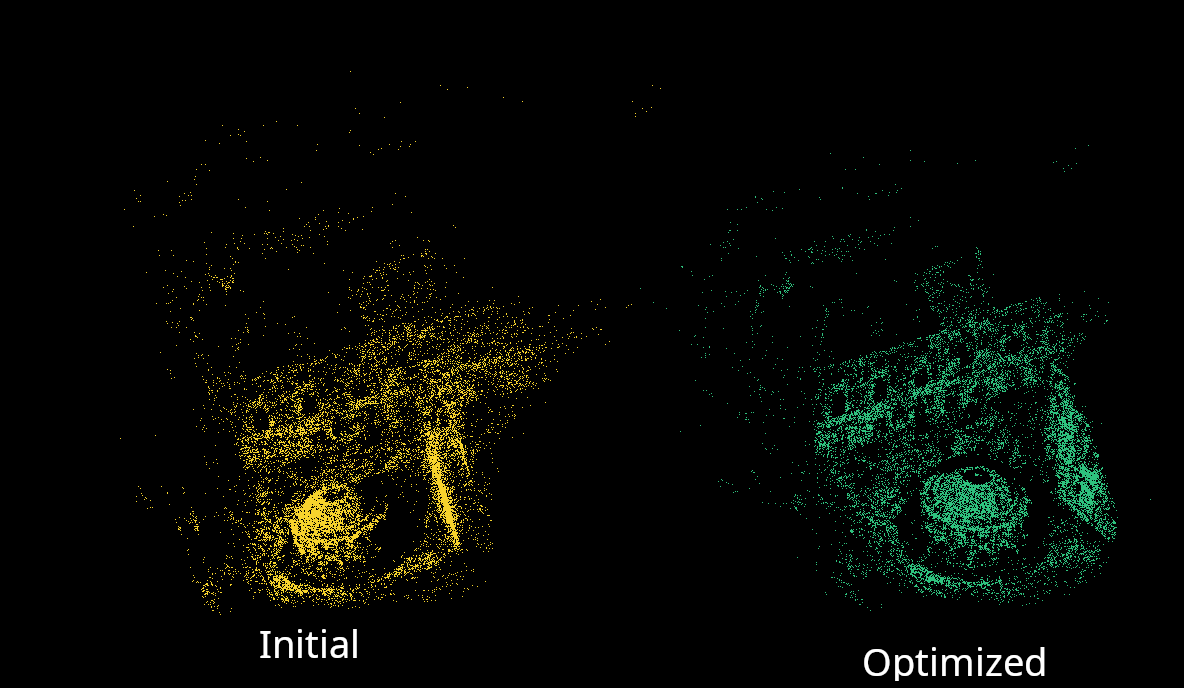
To solve such a non-linear optimization problem, Ceres (Agarwal et al., n.d.) is used. The dataset has been obtained from Grail lab, University of Washington
Triangulation
Let the rows of $P$ be $p_1$, $p_2$ and $p_3$ and $\boldsymbol{X}=(X, Y, Z, 1)^T$. Therefore, \begin{align} su &= p_1X \nonumber \newline sv &= p_2X \nonumber \newline s &= p_3X \end{align} Eliminating $s$, we get \begin{align} (up_3 - p_1)\boldsymbol{X} &= 0 \nonumber \newline (vp_3 - p_2)\boldsymbol{X} &= 0 \end{align} This means that for each observed point we get a pair of equations. If there are multiple observations for the same point from different camera poses, we can stack these together to form an eigenvalue problem of the form \begin{align} A \boldsymbol{X } = 0 \end{align}
The matrix $A$ can be solved using singular value decomposition (SVD)
A very good book to refresh the concepts can be found (Gao et al., n.d.)
Code
A utilities.hpp is created as follows
#pragma once

#include <ceres/ceres.h>
#include <ceres/rotation.h>

#include <Eigen/Dense>
#include <fstream>

namespace bundle_adjustment {
struct CameraParams {
  /*
  params layout:
  [0] rx (angle-axis)
  [1] ry (angle-axis)
  [2] rz (angle-axis)
  [3] tx (translation)
  [4] ty (translation)
  [5] tz (translation)
  [6] focal_length
  [7] k1 (radial distortion)
  [8] k2 (radial distortion)

  */
  double params[9];
};

struct WorldPoint {
  double xyz[3];
};

struct Observation {
  int camera_index;
  int point_index;
  double u;
  double v;
};

/*
Triangulation using Direct Linear Transformation
*/
WorldPoint TriangulateDLT(const std::vector<Observations>& obs) {
  Eigen::MatrixXd A(2 * obs.size(), 4);

  for (size_t i = 0; i < obs.size(); ++i) {
    const auto P = obs[i].P;
    double u = obs[i].u;
    double v = obs[i].v;

    // Row 1: u * P3 - P1
    A.row(2 * i) = u * P.row(2) - P.row(0);
    // Row 2: v * P3 - P2
    A.row(2 * i + 1) = v * P.row(2) - P.row(1);
  }

  // Solve A*X = 0 using SVD
  // The solution is the eigenvector corresponding to the smallest eigenvalue
  Eigen::JacobiSVD<Eigen::MatrixXd> svd(A, Eigen::ComputeFullV);
  Eigen::Vector4d X_homo = svd.matrixV().col(3);

  // Convert from homogeneous to Euclidean
  WorldPoint world_pts;
  Eigen::Vector3d wp(X_homo.head<3>() / X_homo(3));
  world_pts.xyz[0] = wp(0);
  world_pts.xyz[1] = wp(1);
  world_pts.xyz[2] = wp(2);

  return world_pts;
}

struct BALProblem {
  int num_cameras;
  int num_points;
  int num_observations;

  std::vector<Observation> observations;
  std::vector<CameraParams> cameras;
  std::vector<WorldPoint> points;

  bool LoadFile(const std::string& filename) {
    std::ifstream file(filename);
    if (!file.is_open()) return false;

    // 1. Read the header
    file >> num_cameras >> num_points >> num_observations;

    // 2. Read the observations
    observations.resize(num_observations);
    for (int i = 0; i < num_observations; ++i) {
      file >> observations[i].camera_index >> observations[i].point_index >>
          observations[i].u >> observations[i].v;
    }

    // 3. Read the camera parameters (9 per camera)
    cameras.resize(num_cameras);
    for (int i = 0; i < num_cameras; ++i) {
      for (int j = 0; j < 9; ++j) {
        file >> cameras[i].params[j];
      }
    }

    // 4. Read the point parameters (3 per point)
    points.resize(num_points);
    for (int i = 0; i < num_points; ++i) {
      for (int j = 0; j < 3; ++j) {
        file >> points[i].xyz[j];
      }
    }

    return true;
  }

  void WriteToPLY(const std::string& filename) {
    std::ofstream ofs(filename);
    ofs << "ply\nformat ascii 1.0\n"
        << "element vertex " << num_points << "\n"
        << "property float x\nproperty float y\nproperty float z\n"
        << "end_header\n";

    for (const auto& p : points) {
        ofs << p.xyz[0] << " " << p.xyz[1] << " " << p.xyz[2] << "\n";
    }
}
};

struct ReprojectionError {
  ReprojectionError(double observed_x, double observed_y)
      : observed_x_(observed_x), observed_y_(observed_y) {}

  template <typename T>
  bool operator()(const T* const camera, const T* const point,
                  T* residuals) const {
    const T* angle_axis = camera + 0;
    const T* translation = camera + 3;
    const T& focal = camera[6];
    const T& k1 = camera[7];
    const T& k2 = camera[8];

    T p[3];
    ceres::AngleAxisRotatePoint(angle_axis, point, p);

    // Translate the point
    p[0] += translation[0];
    p[1] += translation[1];
    p[2] += translation[2];

    // Project to image plane
    T xp = -p[0] / p[2];  // negative because cam img plane is behind
    T yp = -p[1] / p[2];

    T r2 = xp * xp + yp * yp;
    T rp = T(1.0) + k1* r2 + k2* r2* r2;

    // Apply intrinsics
    T predicted_x = focal * rp * xp;
    T predicted_y = focal * rp * yp;

    // 5. Compute residuals
    residuals[0] = predicted_x - T(observed_x_);
    residuals[1] = predicted_y - T(observed_y_);

    return true;
  }

  // Factory to hide the construction of the CostFunction object
  static ceres::CostFunction* Create(double observed_x, double observed_y) {
    return new ceres::AutoDiffCostFunction<ReprojectionError, 2, 9,
                                           3>(  // 2 residuals, 9 camera params,
                                                // 3 point params
        new ReprojectionError(observed_x, observed_y));
  }

  double observed_x_;
  double observed_y_;
};

}  // namespace bundle_adjustment
The main.cpp is as follows
#include <fstream>
#include <iostream>
#include <string>
#include <vector>

#include "utilities.hpp"

namespace ba = bundle_adjustment;

int main(int argc, char** argv) {
  ba::BALProblem data;
  // if (data.LoadFile("problem-16-22106-pre.txt")) {
  if (data.LoadFile("problem-135-90642-pre_dubrovnik.txt")) {
    std::cout << "Loaded " << data.num_cameras << " cameras and "
              << data.num_points << " points." << std::endl;
  }

  ceres::Problem problem;
  for (const auto& obs : data.observations) {
    double* cam_params = data.cameras[obs.camera_index].params;
    double* landmarks = data.points[obs.point_index].xyz;
    double u = obs.u;
    double v = obs.v;

    // Create Cost Function
    ceres::CostFunction* cost_function = ba::ReprojectionError::Create(u, v);

    // Add Residual Block
    problem.AddResidualBlock(
        cost_function,
        new ceres::HuberLoss(1.0),  // Robust loss against outliers
        cam_params, landmarks);
  }
  problem.SetParameterBlockConstant(data.cameras[0].params);

  ceres::Solver::Options options;
  options.linear_solver_type = ceres::SPARSE_SCHUR;
  options.minimizer_progress_to_stdout = true;
  options.num_threads = 16; // Use multiple cores
  options.preconditioner_type = ceres::SCHUR_JACOBI;
  options.max_num_iterations = 200;

  ceres::Solver::Summary summary;
  std::cout << "Solving..." << std::endl;

  data.WriteToPLY("initial_dubrovnik.ply");

  ceres::Solve(options, &problem, &summary);

  data.WriteToPLY("optimized_dubrovnik.ply");

  std::cout << summary.FullReport() << "\n";
  return 0;
}
The CMakeLists.txt
cmake_minimum_required(VERSION 3.5)
project(ba_uni_washington)

set(CMAKE_CXX_STANDARD 17)
set(CMAKE_CXX_STANDARD_REQUIRED ON)

find_package(Ceres REQUIRED)
find_package(Eigen3)

include_directories(
    include
    ${EIGEN3_INCLUDE_DIRS}
)

add_executable(bundle_adjustment
    bundle_adjustment.cpp
)
target_link_libraries(bundle_adjustment
    PRIVATE ceres
    ${EIGEN3_LIBRARIES}
)
install(TARGETS bundle_adjustment
    DESTINATION lib/${PROJECT_NAME}
)
Results
References
- Ceres Solver
- 14 Lectures on Visual SLAM: From Theory to Practice